

How to Tell If Gold Is Real: Gold-Plated vs. Gold-Filled vs. Solid Gold

You discover an old necklace in a jewelry box. It's gold-colored, surprisingly heavy, and looks like something that could be valuable.
But is it real gold?
This is one of the most important questions to answer before selling unwanted jewelry, especially when dealing with inherited pieces, vintage necklaces, antique rings, or items purchased many years ago.
The difference between solid karat gold, gold-filled jewelry, and gold-plated jewelry can dramatically affect an item's precious-metal value.
At League City Coin & Gold, we help customers throughout League City, Clear Lake, Friendswood, and Greater Houston evaluate gold jewelry and other precious metals.
Here's what you should know before deciding whether your jewelry is worth selling.
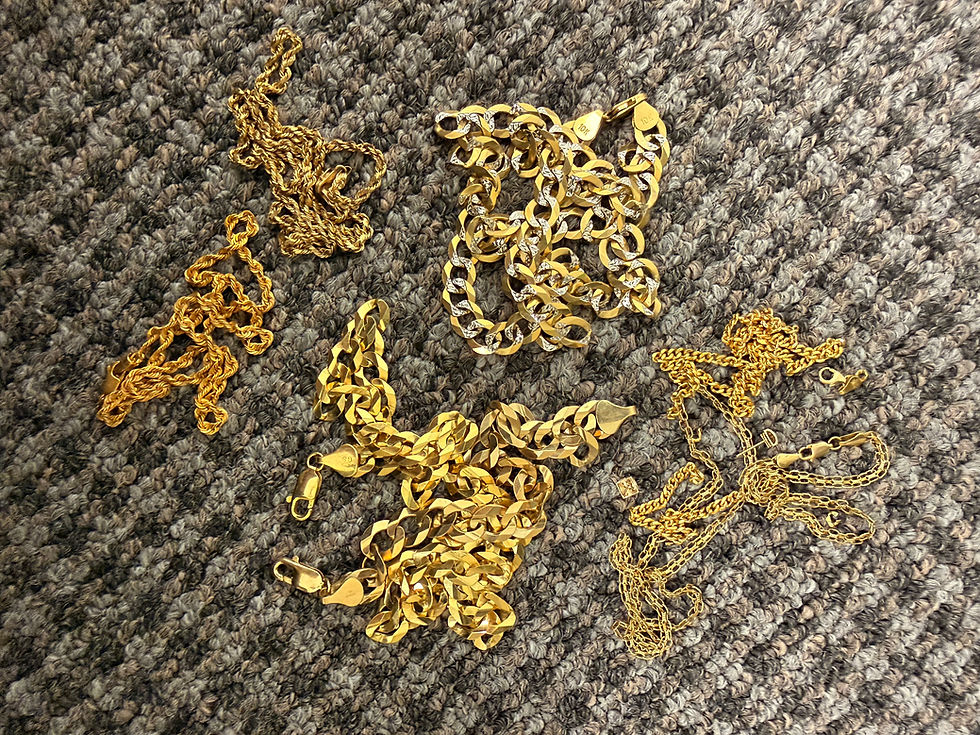
1. Check Your Jewelry for Gold Markings
One of the easiest places to begin is by examining the markings inside a ring, near a necklace clasp, or on the back of a pendant.
These markings are often called hallmarks or quality marks.
Common examples include:
Marking | What It Usually Means |
10K or 417 | Approximately 41.7% gold |
14K or 585 | Approximately 58.3% gold |
18K or 750 | 75% gold |
22K or 916 | Approximately 91.7% gold |
24K or 999 | Nearly pure gold |
GF | Gold-filled |
RGP | Rolled gold plate |
GP | Gold-plated |
HGE | Heavy gold electroplate |
These markings provide valuable clues, but they are not proof of authenticity.
Counterfeit jewelry can carry misleading stamps, and genuine older jewelry may have worn or missing markings.
An unmarked piece should not automatically be dismissed as fake.
2. Understand the Difference Between Solid Gold and Gold-Plated Jewelry
Two pieces can look nearly identical while containing very different amounts of precious metal.
Solid Karat Gold
Solid karat gold jewelry is made from gold alloy throughout the relevant metal components, rather than simply having a gold coating.
For example, a genuine 14K gold ring contains approximately 58.3% gold.
The remaining material consists of other metals that contribute strength, durability, and color.
Because gold is present throughout the alloy, solid karat gold jewelry generally has meaningful precious-metal value even when damaged or outdated.
A broken 14K gold necklace can still have value based on its recoverable gold content.
Gold-Plated Jewelry
Gold-plated jewelry consists of a base material covered by a relatively thin layer of gold.
The underlying metal might be brass, copper, or another alloy.
Although the piece may look like solid gold, the actual gold content can be very small.
This is why a gold-plated necklace weighing 30 grams should not be valued the same way as a genuine 30-gram 14K gold necklace.
Gold plating can wear away over time, revealing the material underneath.
Gold-Filled Jewelry
Gold-filled jewelry uses a mechanically bonded layer of gold alloy over a base metal.
Gold-filled pieces generally contain more gold than ordinary thinly plated jewelry, but they should not be confused with solid karat gold.
For example, the marking "1/20 14K GF" indicates that the 14K gold alloy layer makes up one-twentieth of the item's metal weight.
That does not mean the entire item is 14K gold.
The gold content may have some recoverable value, but resale and refining considerations differ substantially from those for solid gold.
3. Does Real Gold Stick to a Magnet?
Gold itself is not ferromagnetic, meaning it does not behave like iron when exposed to an ordinary magnet.
If a piece strongly sticks to a magnet, that suggests the presence of magnetic materials.
However, the magnet test has important limitations.
Some genuine gold jewelry includes magnetic components, such as certain clasp springs. Many non-gold metals are also nonmagnetic.
Therefore, a piece passing the magnet test does not prove that it is real gold.
Use this only as a preliminary observation—not a final authentication method.
4. Can You Identify Real Gold by Its Color?
Color is not a reliable way to authenticate gold.
Real gold jewelry comes in several appearances, including yellow gold, white gold, and rose gold.
White gold is made by combining gold with other metals and may have a rhodium coating.
Rose gold typically gets its pinkish color from copper in the alloy.
Meanwhile, modern gold-plated jewelry can closely resemble genuine karat gold.
A bright yellow appearance does not prove high purity, and a faded surface does not automatically mean the entire piece is fake.
5. What About the Vinegar Test or Ceramic Scratch Test?
You may have seen online videos recommending household tests to identify genuine gold.
Some suggest applying vinegar, scratching jewelry against unglazed ceramic, or using other household materials.
These tests can be misleading and may damage valuable jewelry.
Scratching an antique ring or applying chemicals to a piece with gemstones may reduce its resale value or harm its finish.
For jewelry that could have financial or sentimental value, professional evaluation is a safer approach.
6. How Do Professional Gold Buyers Test Jewelry?
Professional gold evaluation may involve several techniques.
These can include visual examination, checking quality marks, weighing appropriate components, electronic or chemical testing, and X-ray fluorescence analysis.
Each method has limitations.
For example, X-ray fluorescence primarily measures material near the surface, so thick plating or unusual construction can require additional verification.
A knowledgeable buyer uses the appropriate methods for the item rather than assuming one quick test always settles the question.
7. Is Unmarked Gold Jewelry Worth Anything?
Yes, potentially.
A missing stamp does not automatically mean jewelry has no gold value.
Older jewelry, custom-made pieces, and heavily worn items may lack readable quality marks.
Some jewelry has also been resized or repaired, which can remove or obscure original markings.
If you have an unmarked ring or necklace that you suspect is genuine gold, consider having it examined before discarding it.
8. Where Can You Sell Real Gold Jewelry Near League City?
If you have gold jewelry you no longer wear, understanding its purity and actual metal content is an important first step.
At League City Coin & Gold, we purchase gold jewelry, scrap gold, coins, and other precious-metal items.
Customers from League City, Clear Lake, Webster, Friendswood, Seabrook, Dickinson, and surrounding Houston communities can bring eligible items for evaluation.
You can explore our precious-metals buying services to learn more.
Frequently Asked Questions
Is a necklace marked 14K always real gold?
No. A 14K marking suggests the item is intended to contain approximately 58.3% gold, but markings can be counterfeit or misleading.
Does gold-plated jewelry have resale value?
It may have fashion, designer, or collectible value. Its recoverable gold content, however, is generally much lower than that of comparable solid karat gold jewelry.
Can broken gold jewelry still be sold?
Yes. Broken solid gold jewelry may still retain precious-metal value based on its purity and recoverable weight.
Does real gold tarnish?
Pure gold is highly resistant to tarnishing, but lower-karat gold alloys contain other metals that can react with the environment. Surface coatings and contamination can also affect appearance.
Can I sell gold without knowing its karat?
Yes. You do not need to identify a piece's karat purity yourself before having it evaluated.
Find Out Whether Your Jewelry Contains Real Gold
An old necklace, inherited ring, or broken bracelet may contain more gold than you realize.
Before giving it away or accepting an offer, find out what you actually own.
League City Coin & Gold serves customers throughout the League City and Clear Lake area.
Visit us at 17000 El Camino Real, Suite 209, Houston, TX 77058, or call (346) 651-6099.
Learn more about what we buy and how we evaluate precious metals.


Comments